

Cheltenham Civic Society (CCS) was asked by a GlosLive reporter if we had any comments on the structure being built in front of 131’s three Grade II* listed buildings on the Prom. We checked with the enforcement officers at Cheltenham Borough Council (CBC) and learned that they had issued a ‘stop work’ order on Monday 17th August because planning conditions had yet to be discharged. We then sent the reporter the following response.
CCS is seriously concerned about the permanent structure now being erected outside 131 Promenade.
We have examined the structure against the approved drawings and have identified what appear to be a number of significant differences.
We are also concerned that the application for the Discharge of Conditions for the approved work was only submitted on Monday 17 August, some four weeks or more after work started. If confirmed, these would represent serious breaches of the planning permission and listed building consent and raise wider questions about the approach being taken to planning compliance.
We are also concerned that 131’s statement talks about materials for the sides of the structure when there is no consent for anything on the sides – removable or not. The structure is to be open-sided.
This is particularly concerning because the structure is being built in precisely the location that Historic England, the Georgian Group, the Council’s own Conservation Officer, the Cheltenham Architects’ Panel, and Cheltenham Civic Society expressed serious concerns about.
Historic England warned that development in front of the principal elevations of the Grade II* Regency villas would harm their significance, describing the proposed frame as ‘visually unrefined’ and ‘utilitarian and unrelenting’. It also warned that approval could set ‘a very harmful precedent’ for other sensitive historic environments.
The Georgian Group was equally clear, saying the proposals would create ‘an unacceptable visual distraction’, obscuring original features and ‘competing with and dominating’ the highly-designated buildings.
The Council’s Conservation Officer described the impact on the listed buildings’ setting as ‘permanent’ and ‘significant’, warning that the development would represent ‘an unprecedented form of development’ within the curtilages of Grade II* listed buildings in Cheltenham.
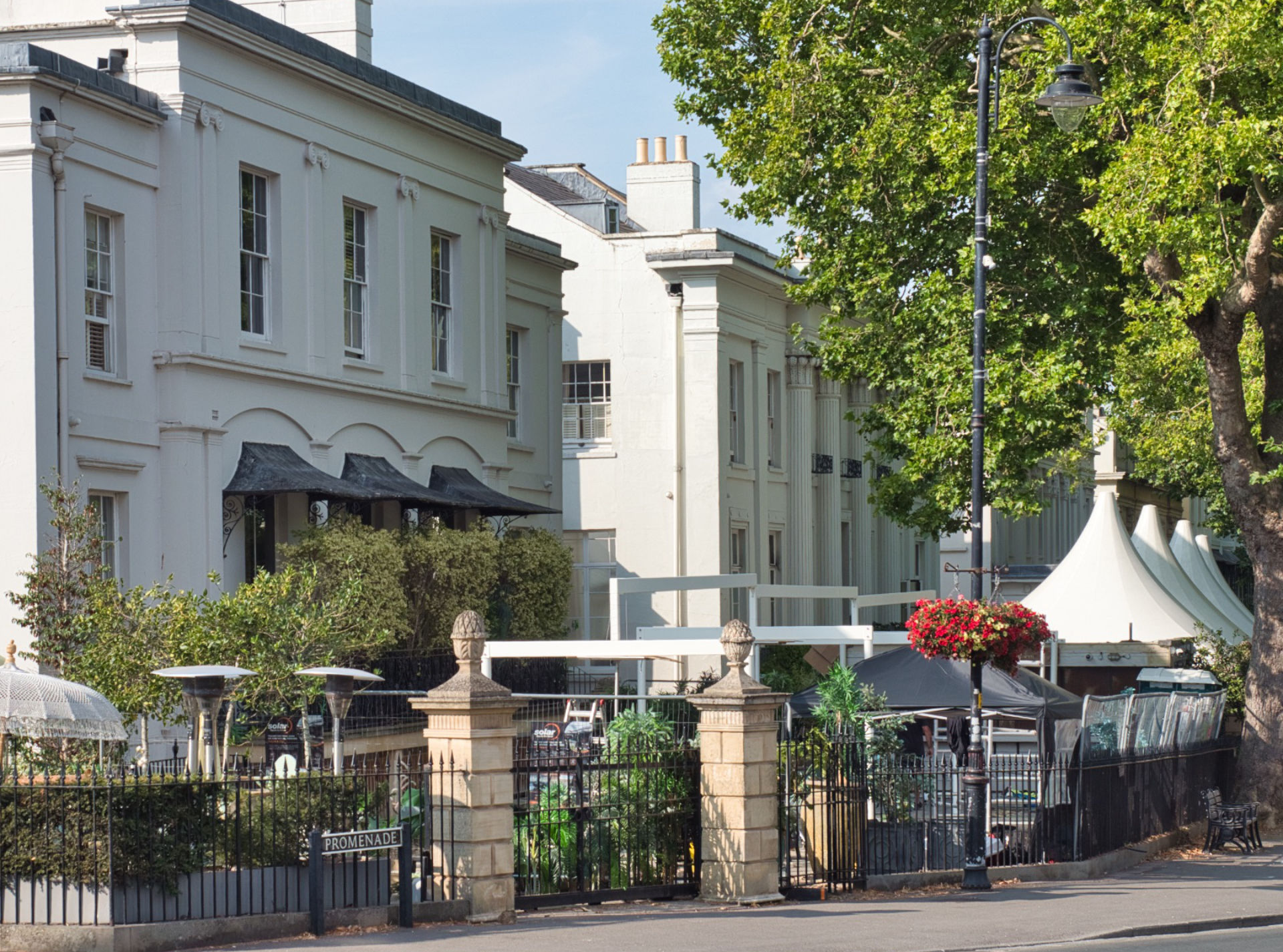
CCS’s own objection was made in the strongest terms. We warned of huge damage to the setting and appearance of three exceptionally fine buildings and argued that the structures would become the dominant feature, obscuring architectural detail and greatly reducing appreciation of their architecture.
We recognise that planning permission has now been granted for a permanent structure, and that decision must be respected. But permission to build something does not amount to permission to build something different, no matter how seemingly minor the changes.
The planning system depends upon approved drawings and conditions being followed. Where a developer departs from what has been approved, the Council must be prepared to act decisively, especially in a location of such exceptional heritage significance.
This is therefore not simply a question of architectural detail. It is a test of whether planning permission and listed building consent mean what they say, whether heritage protection has any real force and whether Cheltenham Borough Council is prepared to enforce the standards.
CCS has asked the Council to investigate the apparent discrepancies urgently and, if breaches are confirmed, to take appropriate enforcement action.”
We also learnt from CBC that 131 had lost its second and final appeal against CBC’s previous enforcement notice ordering 131 to remove its original forecourt tents. The planning inspectorate’s decision can be read here: